
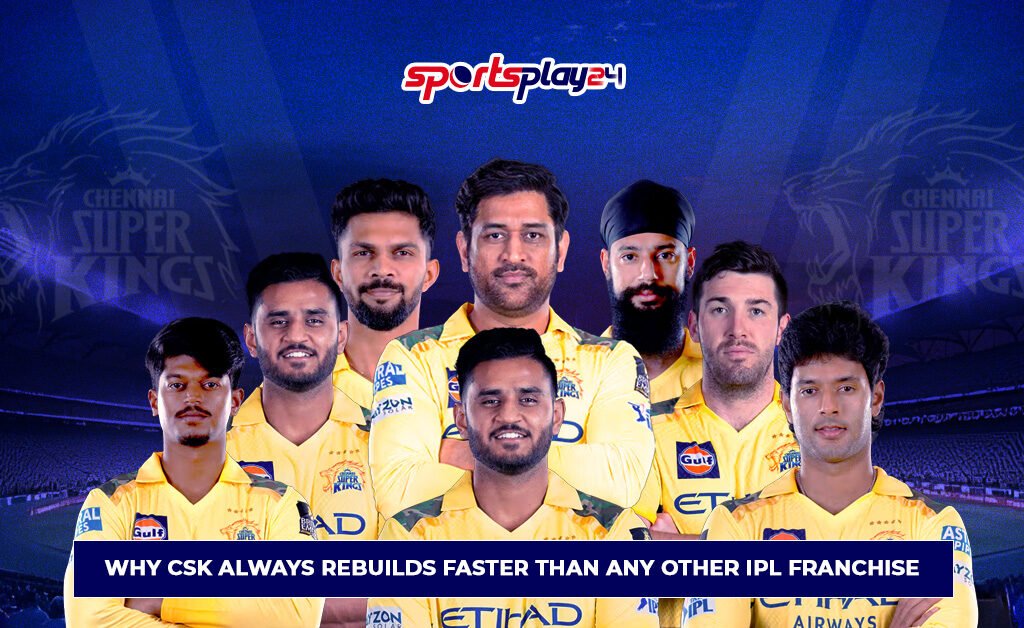
Every few IPL seasons, cricket pundits write CSK off. The squad looks aged. Key players retire. The auction purse runs thin. Yet somehow, Chennai Super Kings return — not just competitive, but dominant. It is not luck. It is not nostalgia. It is a CSK team rebuilding strategy so deeply embedded in the franchise’s DNA that it operates almost automatically. This article breaks down exactly why CSK rebuilds faster, smarter, and more sustainably than any other IPL franchise.
From Dhoni’s leadership philosophy to the franchise’s auction intelligence, from their loyalty-first culture to their fearless use of youngsters — every pillar of the Chennai Super Kings success formula is examined below.
The Foundation: CSK’s Philosophy Is Built for the Long Game
Most IPL franchises chase short-term glory. CSK chases systems. While other teams overhaul their squads every two seasons, Chennai operates on a philosophy of incremental evolution — retaining what works, reinforcing what doesn’t, and trusting processes over panic.
Three core beliefs define their approach:
- Loyalty over novelty — retain match-winners even when form dips temporarily
- Data over hype — bid on undervalued players, not trending names
- Culture over talent — fit in the CSK dressing room matters as much as ability
This is not accidental. It reflects a conscious decision made at the top of the organization — from the N. Srinivasan era through to today — that sustained excellence beats cyclical brilliance.
The Dhoni Factor: Leadership That Outlasts Individuals
No discussion of the CSK team rebuilding strategy is complete without addressing MS Dhoni. His value to Chennai is not just in wickets or six-hitting — it is in institutional memory. Dhoni remembers what worked in 2011. He knows which pressure situations broke which players. He calibrates new recruits against that mental database every season.
More critically, Dhoni de-risks rebuilding. When a new youngster walks into the CSK setup, they are mentored by arguably the greatest IPL captain of all time. The psychological safety this creates — knowing Dhoni backs you through early failures — accelerates player development at a rate no other franchise can replicate.
Even after handing the captaincy to Ruturaj Gaikwad, Dhoni’s influence as a senior player and franchise icon ensures that the CSK culture — calm, methodical, trust-first — remains intact. That culture is the rebuilding mechanism.
Auction Intelligence: Why CSK Always Finds Value Others Miss
The IPL auction is where rebuilding begins — and CSK’s scouting and bidding teams are consistently the most disciplined in the room. While franchises like KKR or PBKS sometimes blow their budget chasing marquee foreign all-rounders, CSK routinely identifies underpriced, high-ceiling Indian players who fit specific role requirements.
How CSK Approaches Auctions Differently
- Role-based targeting: They enter the auction with a clear batting-order map and fill slots, not star positions
- Patience at the table: CSK rarely gets dragged into bidding wars. They drop out early and revisit the same player at a lower price when interest cools
- Domestic track-record bias: Ranji Trophy and Vijay Hazare performances are weighted heavily, not just T20 numbers
- The ‘slow burn’ pick: CSK regularly drafts players others have given up on — and rehabilitates them into match-winners
Ruturaj Gaikwad himself is the perfect example. Repeatedly overlooked at domestic level, CSK picked him at a modest price, gave him time, and developed him into an Orange Cap winner and future India captain. That process — spot, invest, develop — is repeatable, and CSK has refined it over 17 seasons.
The Retention Strategy: Why CSK Rarely Starts From Zero
One of the least-discussed aspects of the Chennai Super Kings success formula is how they use retention rules to their maximum advantage. While other franchises release proven performers to save money or accommodate overseas slots, CSK holds onto their core — even when it costs them.
This has a compounding effect. When you retain 4–5 core players across a mega-auction cycle, the new players joining the squad are not building team identity from scratch — they are joining an already-functional unit with established leadership, communication patterns, and tactical understanding. The integration process is dramatically shortened.
Contrast this with the typical RR or PBKS approach:
- Release 6–8 core players after a poor season
- Spend heavily at auction to reconstruct
- New combinations fail to gel in Year 1
- Repeat the cycle after another disappointment
CSK’s model avoids that loop entirely. Their rebuild is more of a refresh than a rebuild — which is why it looks so effortless from the outside.
Youth Development Without Panic: The CSK Way
A common criticism of CSK in the mid-2010s was that they relied too heavily on veterans. That narrative aged poorly. By the 2020s, CSK had systematically seeded their squad with young Indian talent — and gave them something most teams don’t: patience.
In an IPL ecosystem defined by pressure and instant results, CSK creates pockets of safety for developing players. A youngster who fails in two games is not dropped — they are brought back, guided, and given context. This reduces the psychological fragility that derails talented players at other franchises.
The result: when CSK needs to rebuild around youth, they already have a batch of players who have been in the system for 2–3 years, understand the franchise’s demands, and are ready to step up. There is no transition period. The machine simply shifts gears.
Why CSK Always Wins: The Mental Architecture of a Champion Franchise
Behind every tactical advantage CSK holds, there is a deeper psychological infrastructure that explains why CSK always wins when others crumble under pressure.
1. Pressure Is Normalized, Not Feared
CSK has played more knockout games, more Super Overs, and more last-over finishes than almost any franchise. This repeated exposure to high-stakes situations builds an organisational muscle memory. New recruits absorb this culture — they are told, explicitly and implicitly, that pressure is CSK’s natural habitat.
2. The ‘Process Over Result’ Mindset
Dhoni’s famous phrase — ‘the process is more important than the result’ — is not a motivational poster line at CSK. It is a operating principle. Players are evaluated on how well they execute their role, not just on outcomes. This takes pressure off individuals and puts it on execution — which is far more controllable.
3. The Chennai Crowd as a Home Advantage Multiplier
Chepauk is one of the loudest, most intimidating home grounds in world cricket. CSK harnesses this deliberately. New players are integrated into Chepauk’s atmosphere early — it becomes a source of confidence rather than pressure. This home advantage compounds across rebuilds: even a new-look CSK team has a significant psychological edge at home.
CSK vs Other Franchises: A Rebuilding Comparison
To appreciate just how different CSK’s rebuilding approach is, consider a direct comparison with franchises that have struggled with consistency:
CSK vs Mumbai Indians: MI are the only franchise that rivals CSK’s title count — and notably, they share some philosophical DNA: strong captaincy (Rohit Sharma), clear retention priorities, and a development pipeline. MI rebuilds take slightly longer because their support structure outside of Rohit is less consistent.
CSK vs KKR: KKR have two titles but their rebuilds are notoriously unpredictable. Heavy reliance on overseas players, frequent captain changes, and erratic auction strategies mean their rebuilds often take 3–4 seasons.
CSK vs RCB: RCB’s rebuilding struggles are legendary. Despite having Virat Kohli for 15+ seasons, RCB has never won an IPL title — a reflection of how individual brilliance without systemic thinking cannot sustain a franchise.
CSK vs PBKS/RR/SRH: These franchises lack the combination of leadership continuity, cultural identity, and auction intelligence that CSK has. Their rebuilds are reactive, not proactive — they respond to failure rather than building ahead of it.
Case Study: CSK’s Title Run After the 2022 Slump
In 2022, CSK finished ninth — their worst-ever IPL season. Most franchises would have panicked. CSK responded by backing Ruturaj Gaikwad as their next captain, retaining their bowling core, and making targeted additions at auction. One season later, they won their fifth IPL title in 2023.
This is the clearest proof of the CSK rebuilding model in action. The franchise did not change its philosophy in response to failure — it doubled down on it. They trusted their systems, their culture, and their people. That trust was rewarded almost immediately.
What other franchise has gone from ninth to champion in one season? The answer speaks for itself.
Conclusion
The CSK team rebuilding strategy is not a secret. It has been on display for nearly two decades. It is built on leadership continuity, patient youth development, disciplined auction strategy, and an unshakeable franchise culture that absorbs new talent and makes it better.
Other franchises have more money, bigger markets, and arguably stronger individual squads at various points. Yet none of them consistently recover and compete the way Chennai does. The reason is simple: CSK does not rebuild. CSK reloads — because the foundation never truly breaks.Until other IPL franchises build the same philosophical bedrock — and sustain it through bad seasons — the answer to why CSK always wins will remain the same. They never stopped being ready.

