
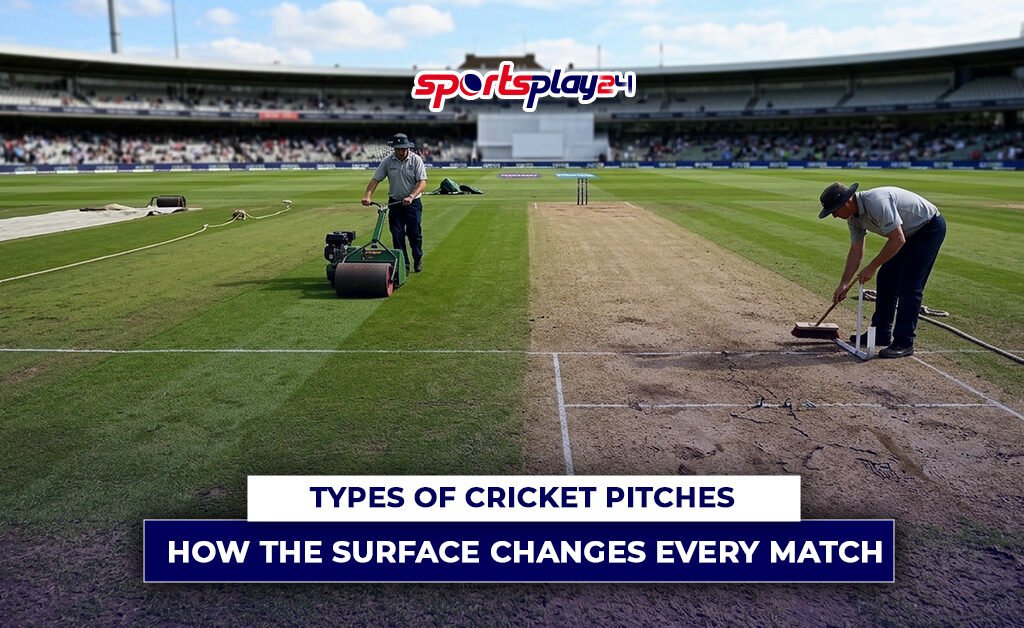
Have you ever wondered why a batsman who scores a century in England might struggle for runs in India the very next week? The answer almost always lies in the types of cricket pitches used at each venue. The pitch, a 22-yard strip of compacted soil, is the most decisive factor in any cricket match. It dictates who dominates: batsmen, fast bowlers, or spinners.
In this complete guide, you will learn how each type of pitch is different, which famous grounds use which surfaces, and how curators prepare them for different formats.
Why Does the Cricket Pitch Matter So Much?
The cricket pitch refers to the central rectangular strip of the playing field where bowling and batting take place. According to ICC Playing Conditions, the pitch must be 22 yards (20.12 metres) long and 10 feet (3.05 metres) wide. Its surface clay, grass, or cracked soil directly determines how the ball behaves after it lands.
A fast, bouncy pitch will encourage bowlers to attack with pace. A dry, dusty surface will crumble and turn sharply for spinners. And a flat, firm surface will reward batsmen with even bounce and easy strokeplay.
In short, the pitch can single-handedly shift a match result even before a single ball is bowled. This is why teams study pitch reports obsessively and captains inspect the surface closely on the morning of a match.
READ ALSO – All Types of Cricket Shots Explained
Batting-Friendly Pitches: Characteristics and Famous Examples
What Is a Batting-Friendly Pitch?
A batting-friendly pitch also called a flat pitch or road has a firm, even surface with very little grass. The soil is usually well-rolled before a match, which creates a hard, consistent bounce. Batsmen love these surfaces because they can play their shots with confidence.
Key characteristics of a batting-friendly pitch include:
- Low and even bounce – the ball stays at a predictable height
- Minimal seam movement – the ball does not deviate sideways off the pitch
- Hard, compact surface – allows the ball to come on to the bat
- Wears slowly – stays good for batting even in the later stages of a Test match
Famous Batting-Friendly Grounds
The Dubai International Stadium and Abu Dhabi’s Sheikh Zayed Cricket Stadium are well-known for their flat, lifeless pitches, scores of 300+ in ODIs are common there. In India, Eden Gardens (Kolkata) and the Rajiv Gandhi International Stadium (Hyderabad) have also produced some of cricket’s highest scores in T20Is and ODIs.
The highest ODI total ever 481/6 by England against Australia at Trent Bridge in 2016 was achieved on a true, flat batting track. High-scoring IPL games at venues like the Wankhede Stadium in Mumbai similarly reflect pitches prepared to favour big hitting.
Seam-Friendly Pitches: Where Fast Bowlers Rule
What Makes a Pitch Seam-Friendly?
A seam-friendly pitch often called a green-top or seaming track has a good covering of fresh, moist grass. When a fast bowler lands the ball on this surface, the seam (the stitched ridge running around the ball) grips the grass and can cause the ball to deviate sharply in any direction. This makes batting extremely difficult.
A seaming pitch will also offer bounce, which means short-pitched deliveries can be dangerous. The conditions favour medium-fast and fast bowlers who can exploit the movement.
READ ALSO – Technology in Modern Cricket
Notable Seam-Friendly Venues
Lord’s Cricket Ground in London and Headingley in Leeds are classic examples of seam-friendly venues. Conditions in New Zealand particularly at Basin Reserve in Wellington are also renowned for helping fast bowlers. In South Africa, Newlands in Cape Town regularly produces green surfaces that challenge even the best batsmen.
A memorable example came during the 2019 ICC World Test Championship era, when England’s pace attack dismantled Australia at Lord’s on a green-top, with Stuart Broad and James Anderson regularly extracting sharp movement off the surface.
Spin-Friendly Pitches: The Home Advantage for India and Sri Lanka
How a Spin Pitch Works
A spin-friendly pitch is usually dry, dusty, and crumbly. As the match progresses especially from day three onwards in a Test the surface breaks up further. Spinners can grip the rough patches and make the ball turn sharply. The bounce also becomes uneven, making it very hard to judge where the ball will go.
These pitches are common in the Indian subcontinent, where the hot climate accelerates surface deterioration. Teams playing at home deliberately prepare spin tracks to neutralise visiting pace attacks.
Spin Pitches in India and Sri Lanka
The M. A. Chidambaram Stadium in Chennai and the Holkar Cricket Stadium in Indore are famous for dusty surfaces that disintegrate quickly. When India hosted England for the 2021 Test series, the pitch in Chennai drew significant media attention for its dramatic turn from day two onwards, with off-spinner Ravichandran Ashwin and left-arm spinner Axar Patel proving near-unplayable.
Sri Lanka regularly wins Tests at home in Galle, where the Galle International Stadium offers variable bounce and generous turn for spinners like Rangana Herath who claimed over 430 Test wickets largely on such surfaces.
Dual-Nature Pitches: How They Change Over 5 Days
One of the most fascinating things about Test cricket is that a pitch can behave very differently across five days. This is what makes dual-nature pitches also called evolving pitches so important to understand.
On day one, a pitch with a grass covering may heavily assist seam bowlers. As the grass wears away by day two, batting conditions improve. Then from day four onwards, cracks appear, the surface deteriorates, and spinners begin to take control.
This gradual shift means that teams winning the toss must judge which phase of the pitch favours them most. Captains like Steve Waugh and Virat Kohli have often spoken about how reading a pitch correctly can be the difference between winning and losing a close Test match.
Comparison: Day 1 vs Day 4 Pitch Behaviour
| Stage | Pitch Behaviour | Who Benefits |
| Day 1 | Grass present, possible moisture, seam movement | Fast bowlers |
| Day 2 | Grass wearing off, truer bounce, more settled | Batsmen |
| Day 3 | Even surface, good for big partnerships | Batsmen |
| Day 4 | Cracks appear, uneven bounce, rough patches | Spinners |
| Day 5 | Surface crumbled, heavy turn, variable bounce | Spinners dominantly |
How Curators Prepare Pitches for Different Match Formats
A pitch curator also called a groundsman is the expert responsible for preparing the surface before each match. Their job varies significantly depending on the match format.
Test Match Pitch Preparation
For a Test match, curators aim to create a pitch that evolves over five days. They will cut grass to a specific length, apply water to ensure firmness on day one, and then allow the surface to dry and crack naturally during the match. The goal is a fair contest between bat and ball across all five days.
ODI and T20 Pitch Preparation
In limited-overs cricket, curators typically prepare flat, hard pitches that encourage high scoring. The ICC’s rules for the 2023 Cricket World Cup confirmed that pitches at neutral venues would be prepared to ensure competitive totals, often between 280 and 350 in ODIs.
For T20Is and IPL matches, curators often leave a bit of pace and bounce so that big shots carry to the boundary. At the Maharashtra Cricket Association Stadium in Pune, curators have repeatedly delivered fast, true surfaces that produce 200+ totals in IPL.
READ ALSO – Role of All Rounders in Modern Cricket
Curator Influence on Match Outcomes
The curator holds enormous power. If they prepare an extreme spin pitch for a series against a side with weak spinners, the home team gains a significant advantage. The BCCI (Board of Control for Cricket in India) regularly consults its chief curator before major series to ensure the pitch type aligns with team strategy.
Controversial Pitch Decisions in International Cricket History
Not all pitches are praised. Some have sparked major controversy and even disciplinary action from the ICC.
India vs South Africa, Nagpur 2015
The Test match between India and South Africa in Nagpur in November 2015 lasted less than two days. The pitch deteriorated so rapidly from the first morning that South Africa were bowled out twice inside two days. The ICC pitch inspector rated the surface as ‘poor,’ and the stadium received a suspended ban. This was a turning point in how the ICC monitored pitch conditions globally.
India vs England, Ahmedabad 2021
The second Test of England’s 2021 tour to India at the Narendra Modi Stadium drew widespread criticism. The pitch offered a sharp, unpredictable turn from day one, leading England to be dismissed for 112 in their first innings despite winning the previous Test in Chennai. The ICC rated the pitch as ‘below average’ stopping short of a ‘poor’ rating but acknowledging concerns.
ICC Pitch Rating System
Under the ICC’s pitch and outfield monitoring system, match referees rate pitches after every international match as ‘very good,’ ‘good,’ ‘average,’ ‘below average,’ or ‘poor.’ A ‘poor’ rating results in the venue receiving demerit points. Five demerit points in a five-year period can result in a ban from hosting international cricket.
Pitch Conditions at Famous Cricket Grounds Around the World
Different countries and venues have distinctly different pitch characters. Here is a quick overview:
- Lord’s, London (England): Produces early seam movement. Often favours pace on day one. Fast bowlers relish the slope.
- Eden Gardens, Kolkata (India): Generally flat and batting-friendly in the first two days. Spin comes into play later in Tests.
- MCG, Melbourne (Australia): Known for pace and bounce. The MCG traditionally rewards fast bowling and can produce uneven bounce in the second innings.
- Newlands, Cape Town (South Africa): Green, lively surfaces that swing and seam early. Pace bowlers are at a premium here.
- Galle, Sri Lanka: Dusty, crumbling surfaces that spin heavily from day two. One of the most spin-friendly venues in world cricket.
- Barbados, West Indies: Hard, fast pitches that historically allowed West Indian quicks to dominate. Still pace-friendly today.
- Basin Reserve, Wellington (NZ): Windy and green. New Zealand pace bowlers like Trent Boult have exploited this ground consistently.
The Pitch Is the Game’s Great Equaliser
Understanding the types of cricket pitches is essential for any serious fan. Whether it is the seaming green-top at Lord’s, the dusty spinner’s paradise in Chennai, or the flat highway in Dubai, each surface tells a story about conditions, strategy, and cricket culture. Captains who read pitches well give their teams a huge head start. And fans who understand pitch reports will watch every match with a whole new level of insight.
Explore more cricket guides on SportsPlay24 and deepen your knowledge of the game’s most fascinating details.
Frequently Asked Questions
1. What are the main types of cricket pitches?
The main types of cricket pitches are batting-friendly (flat) pitches, seam-friendly (green-top) pitches, spin-friendly (dry/dusty) pitches, and dual-nature pitches that evolve over several days.
2. What happens if a cricket pitch is rated ‘poor’ by the ICC?
Under ICC regulations, a venue receiving a ‘poor’ pitch rating earns demerit points. If a venue accumulates five demerit points within a five-year rolling period, it can be suspended from hosting international cricket matches as was the case when Nagpur faced a suspended ban in 2015.
3. Why do pitches change over five days in a Test match?
As the match progresses, the grass wears off, the surface dries out, and cracks appear. This means that while a pitch may help fast bowlers on day one, it can shift significantly to assist spinners by day four or five as it breaks up and deteriorates.

