
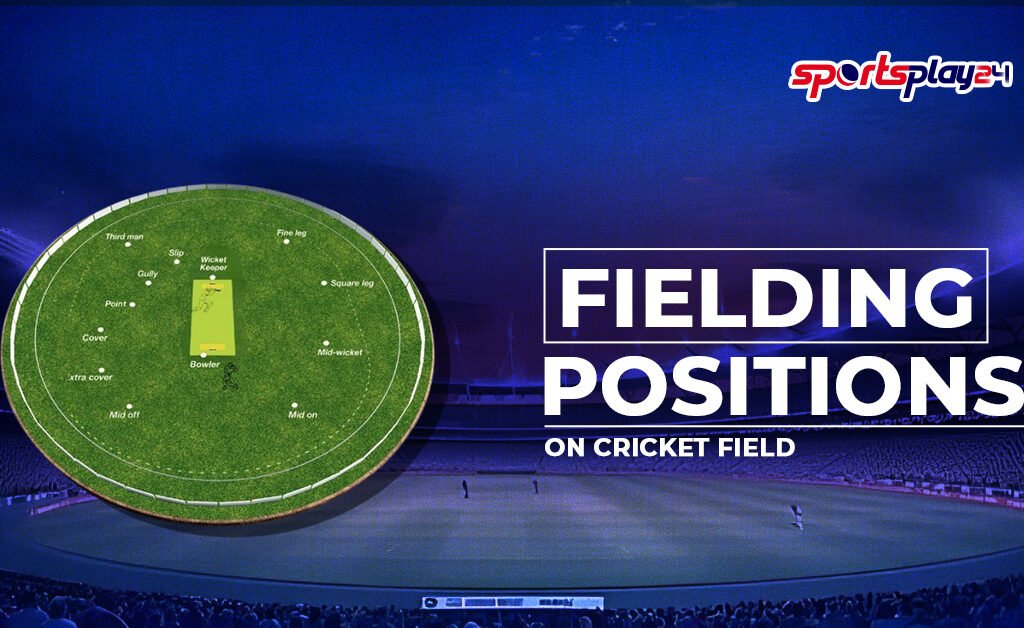
Understanding where each player stands on the field can make cricket far more enjoyable to watch and follow. Fielding Positions in Cricket helps beginners and casual fans decode standard terms like slip, gully, mid-off, and fine leg, and shows how captains set fields for different situations.
From close-catching positions to boundary riders, every spot has a specific purpose. In this guide, we break down every fielding position using clear explanations and an easy-to-follow diagram. Whether you’re new to cricket or brushing up on tactics, continue to the next section to master field placements and see how they shape every delivery.
What Are Fielding Positions in Cricket?
Cricket fielding positions are specific areas on the field where players stand to catch, stop, or retrieve the ball. There are 11 fielding positions at any time (including the bowler and wicketkeeper). Positions are named based on their location relative to the batsman, either on the off side (where the bat faces) or leg side (behind the batsman).
Most importantly, these positions change constantly depending on the match situation, bowling type, and the batsman’s playing style. Captains use strategic placement to create pressure or prevent runs.
Cricket Fielding Positions Diagram
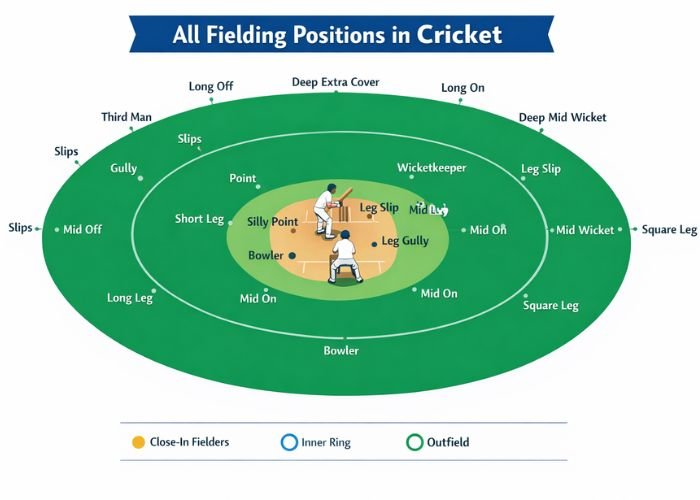
List of All Fielding Positions in Cricket
Close-In Fielding Positions
These fielders stand dangerously close to the batsman, hoping for edges or deflections:
- Slip (First, Second, Third, Fourth): Stand behind the wicketkeeper at an angle. They catch edges when fast bowlers beat the bat.
- Gully: Positioned between the point and the slips. Catches sliced shots that fly between these areas.
- Silly Point: Extremely close on the off side, used mainly against spin bowlers to catch bat-pad chances.
- Silly Mid-Off: Similar to silly point but straighter, almost in line with the stumps.
- Short Leg (Leg Slip): Crouches close on the leg side to catch deflections off the pad or inside edge.
Inner Ring Positions
These fielders save singles and patrol the 30-yard circle:
- Cover: Guards the offside between mid-off and point. Stops drives hit through the covers.
- Point: Stands square on the offside. Intercepts cuts and square drives.
- Mid-Off: Positioned straight on the off side, about 20-25 yards from the batsman.
- Mid-On: Same distance but on the leg side. Stop straight drives.
- Square Leg: Stands square on the leg side, level with the batsman. Often, the umpire’s position is referenced.
- Mid-Wicket: Between square leg and mid-on. Stops flicks and pulls through the leg side.
Outfield Positions
These fielders protect the boundary and catch mishits:
- Long-Off: Deep on the off side, straight from the bowler’s perspective.
- Long-on: Deep on the leg side, protecting straight hits.
- Deep Square Leg: Patrols the leg-side boundary, catches pull shots.
- Third Man: Guards the area behind the point near the boundary. Stops edges and cuts.
- Fine Leg: Positioned behind the wicketkeeper on the leg side, catches glances and hooks.
Off Side and Leg Side Fielding Positions
The off side sits in front of the batter’s body. The leg side stays behind the batter.
| Off Side | Leg Side |
| Slip | Fine leg |
| Gully | Square leg |
| Point | Midwicket |
| Cover | Long-on |
| Deep cover | Deep midwicket |
Fast bowlers attack the off side because edges fly toward slips. Spinners often load the leg side because batters sweep and flick more. Therefore, clever cricket field placement always follows shot patterns.
Cricket Fielding Positions Chart (Names + Roles)
Here’s a quick reference for fielding positions names and their main purpose:
| Position | Area | Main Role |
| Wicketkeeper | Behind stumps | Catches edges, stumping |
| First Slip | Behind keeper (off) | Catches thick edges |
| Gully | Square of slips | Catches cuts and slashes |
| Point | Square (off side) | Stops cuts and square drives |
| Cover | Between point and mid-off | Stops cover drives |
| Mid-Off | Straight (off side) | Stops straight drives |
| Mid-On | Straight (leg side) | Stops on-drives |
| Square Leg | Square (leg side) | Umpire position, stops pulls |
| Fine Leg | Behind keeper (leg) | Catches glances and hooks |
| Third Man | Behind point (boundary) | Stops edges and cuts |
| Long-On | Straight (boundary, leg) | Catches straight hits |
| Long-Off | Straight (boundary, off) | Catches lofted drives |
Conclusion
Mastering all fielding positions in cricket allows you to see the “game within the game.” When you notice a captain moving a player from Mid-off to Extra Cover, you aren’t just seeing a person walk across the grass. You are seeing a tactical adjustment designed to outsmart the batter.
Whether you are studying a cricket fielding positions diagram to improve your own game or just to enjoy the 2026 season more, remember that every position has a purpose. From the bravery of Silly Point to the speed of the Long-on, fielding is the heartbeat of cricket strategy.
FAQ’s
How many fielding positions are in cricket?
With All Fielding Positions in Cricket Explained, you’ll find over 30 named positions, though only 11 players are on the field at one time.
What are the leading cricket fielding positions?
Common positions include slip, gully, point, cover, mid-off, mid-on, square leg, fine leg, and long-on.
Why do fielding positions change often?
Captains adjust positions based on batter style, bowler type, and match situation key concepts in All Fielding Positions in Cricket Explained.
Which fielding position is closest to the batter?
Silly point and short leg are usually the closest, standing just a few meters from the batter.
Do fielding positions differ by format?
Yes. T20S use more boundary riders, while Tests rely on close catchers, details covered in All Fielding Positions in Cricket Explained.
