
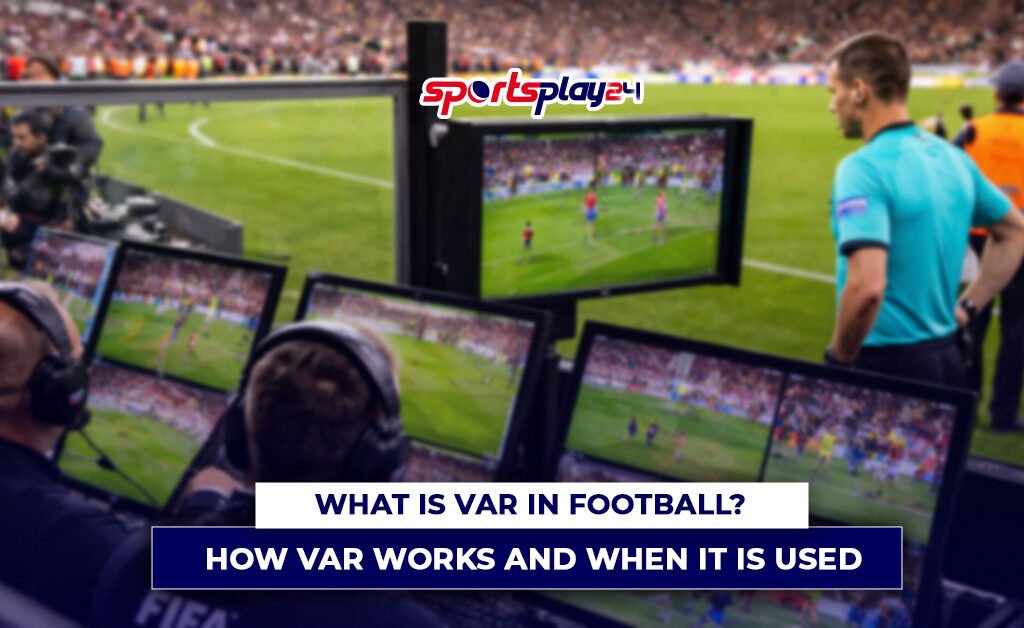
If you have ever watched a football match and wondered why the referee suddenly stopped play to stare blankly into the distance for a minute, you have already witnessed VAR in action. The Video Assistant Referee system has become one of the most talked-about and debated innovations in modern football.
For some fans, it brings justice and accuracy to the game. For others, it has drained the joy out of goal celebrations and turned football into a stop-start affair full of confusion.
Whether you love it or hate it, understanding what is VAR in football, how it works, and when it gets used is essential to making sense of the modern game.
What Is VAR in Football?
VAR stands for Video Assistant Referee. It is a match official system in which a team of video officials, working from a remote video operation room, reviews footage of specific match incidents to assist the on-field referee in making correct decisions.
The system was introduced to football to address what FIFA calls clear and obvious errors, which are major mistakes that a referee could not reasonably detect with the naked eye at full speed. It does not replace the referee but acts as a support tool, giving officials access to multiple camera angles and slow-motion replays.
VAR was first used in top-level football competitions in 2018 and has since been adopted by leagues and tournaments around the world, including the Premier League, La Liga, Serie A, the UEFA Champions League, and the FIFA World Cup.
For a deeper look at how football competitions and officiating evolve, visit the SportsPlay24 Football Hub.
How Does VAR Work?
The VAR system works through a dedicated video operations room, usually located away from the stadium. A team of officials sits at a bank of monitors showing live feeds from multiple cameras positioned around the pitch. When an incident occurs that might warrant a review, the VAR team checks the footage immediately.
The VAR Team
The VAR team typically consists of:
- A Video Assistant Referee, who is a trained and experienced referee themselves
- An Assistant VAR (AVAR), who helps monitor incidents and communicate with the on-field referee
- Replay operators, who control the camera feeds and select the relevant angles
This team works in silence during the match and only communicates with the on-field referee through an earpiece when a reviewable incident arises.
The Review and Intervention Process
Once the VAR team identifies a potential clear and obvious error, they signal to the on-field referee. The referee can then choose one of two paths:
- Accept the VAR recommendation and change their original decision without reviewing footage themselves
- Walk to the pitchside monitor to personally review the footage before making a final call
The second option, known as an On-Field Review (OFR), is used when the referee wants to see the incident with their own eyes before making a call that could change the outcome of the match.
It is important to note that VAR can only intervene in four specific categories of decisions. Outside of those categories, VAR cannot overturn a call, no matter how wrong it appears.
When Is VAR Used? The Four Reviewable Incidents
One of the most common points of confusion around VAR explained is not the technology itself, but knowing when it actually applies. FIFA has outlined four specific match situations where VAR can intervene:
1. Goals and Offences Leading to Goals
This is the most common VAR review. Before a goal is confirmed, the VAR team checks whether the attacking team committed any offence in the build-up. This includes:
- Offside in the build-up or at the moment of scoring
- Handball by an attacking player
- A foul in the build-up that was missed by the referee
- Goalkeeper encroachment on a penalty kick
If a clear and obvious error is identified, the goal can be disallowed. This is the category that has produced the most drama and the most controversy since VAR was introduced.
2. Penalty Decisions
VAR reviews both the awarding and the denial of penalty kicks. If the referee incorrectly awards or fails to award a penalty, the VAR team can intervene. This covers fouls, handballs, and incidents inside the penalty area. However, the standard for intervention is still clear and obvious error, meaning VAR will not step in for subjective 50/50 decisions.
3. Direct Red Card Incidents
VAR can review situations where a straight red card was either given or missed. This includes violent conduct, serious foul play, biting or spitting, and denying an obvious goal-scoring opportunity through foul play. Yellow card decisions and the double yellow card scenario are not covered by VAR.
4. Mistaken Identity
If the referee cautions or sends off the wrong player during a foul or misconduct incident, VAR can intervene to correct the identity. This is the least common use of VAR but remains an important safeguard.
Curious about how VAR decisions have shaped recent results in top competitions? Check out the latest football match analysis and results on SportsPlay24.
How VAR Works in the Premier League
How VAR works Premier League-style has a few distinct characteristics compared to other leagues. The Premier League introduced VAR at the start of the 2019-20 season, making it one of the later top European leagues to adopt the system.
The Premier League uses a centralised hub based at Stockley Park in London, where all VAR decisions are made during match days. Every Premier League match is monitored by a dedicated VAR team from this location.
One key feature of how VAR works in the Premier League is that referees are encouraged to use the pitchside monitor more often. In the early seasons, there was criticism that referees were relying too heavily on the VAR team’s recommendations without reviewing incidents themselves. Adjustments have since been made to increase transparency.
The Premier League has also faced specific criticism around the threshold for what counts as clear and obvious, particularly on handball decisions and tight offside calls where the margins are measured in centimetres. These debates have made VAR controversy a regular feature in post-match discussions across the league.
VAR Offside: The Most Controversial Application
Nothing has generated more VAR controversy than the offside review. VAR offside decisions have become the defining symbol of everything football fans dislike about the system.
Under the laws of football, a player is offside if any part of their body that can legally score a goal is nearer to the opponent’s goal line than both the ball and the second-to-last defender at the moment the ball is played. VAR applies this law with extreme precision, using semi-automated offside technology that draws lines across a player’s body to calculate their exact position.
The problem, in the eyes of many supporters, is that this level of precision has produced absurd results. Goals have been disallowed because a player’s armpit, kneecap, or toenail was fractionally ahead of a defender. These are distances invisible to the human eye, yet they carry the same weight as a player being a full metre offside.
UEFA and FIFA have responded to this criticism by introducing semi-automated offside technology (SAOT) at major tournaments. This system uses player tracking data and multiple cameras to generate faster and more reliable offside calls, reducing the waiting time that fans find so frustrating.
The debate around VAR offside is far from settled, and it remains the most divisive element of the football review system.
The VAR Handball Rule: Why It Causes So Much Confusion
The VAR handball rule has been another major source of controversy, largely because the handball law itself is complex and has changed multiple times since VAR was introduced.
Under the current laws, not every instance of the ball hitting an arm is a handball offence. Match officials must consider:
- Whether the arm was in an unnatural position that made the player’s body unnaturally bigger
- Whether the contact was accidental or deliberate
- Whether an attacking player scored or created a goal-scoring opportunity immediately after the ball hit their own hand or arm
The challenge is that handball is a judgement call, which makes it inherently difficult for VAR to review against a clear and obvious error standard. What one official sees as unnatural, another may judge as natural body movement. This has led to inconsistent decisions and widespread frustration among players, managers, and fans.
The handball law was amended ahead of the 2021-22 season to narrow the scope of accidental handball offences, but debates around the VAR handball rule continue to surface every season.
VAR Controversy: The Biggest Criticisms of the System
VAR controversy has followed the system from its very first days. While the technology itself is sound, the implementation and the laws governing it have attracted relentless criticism. Here are the most common complaints:
It Kills the Atmosphere
Goal celebrations are a fundamental part of the football experience. Since VAR was introduced, fans have become reluctant to celebrate fully, knowing that the goal might be disallowed minutes later. This has fundamentally changed the emotional rhythm of the game.
It Is Too Slow
VAR reviews can take several minutes, interrupting the flow of the match and testing the patience of fans in the stadium and at home. While time has improved, delays remain a significant frustration.
It Is Not Truly Objective
Despite using technology, VAR decisions still involve human judgement. Two officials reviewing the same incident can reach different conclusions, particularly on handball, foul, or penalty decisions. This means VAR does not eliminate controversy but simply adds a layer of process to it.
Lack of Transparency
Unlike in rugby or cricket, where the decision-making process is communicated to fans in the stadium and at home in real time, football VAR reviews often leave supporters confused about what is being reviewed and why. Many leagues have taken steps to improve communication, but transparency remains an issue.
It Favours Technicality Over Intent
The most-cited example of this is the semi-automated offside system, which disallows goals because of centimetre differences that have no bearing on whether a player gained any actual advantage. Critics argue that VAR has prioritised technical accuracy over the spirit of the game.
For the latest football opinion pieces, referee decisions, and expert analysis of VAR calls, visit SportsPlay24 Football Opinion.
Has VAR Improved Football?
The honest answer is: it depends on who you ask. Studies from leagues that have adopted VAR show that refereeing accuracy has improved significantly. Researchers have found that the rate of incorrect decisions has dropped noticeably in competitions using VAR compared to those that do not.
At the same time, the perception of fairness has not necessarily improved at the same rate. Fans who feel the rules themselves are unclear, or that the threshold for intervention is applied inconsistently, remain deeply sceptical of the system regardless of the data.
Many football insiders argue that the problem is not VAR itself but the laws of football, particularly around handball and offside, which need to be simplified before VAR can be applied coherently. Others believe the solution is better communication and education so that fans understand what VAR is checking and why.
What most people agree on is that going back to a game with no video review technology at all is not realistic. The question is how to refine VAR so that it serves the game rather than dominating conversations about it after every round of fixtures.
Conclusion
VAR in football is here to stay. What started as a bold experiment to bring greater accuracy to refereeing has become a permanent and defining feature of the modern game. Understanding what VAR is in football, how the football review system operates, and the exact situations in which it applies is essential for any football fan following the sport at the highest level.
The debates around VAR controversy, the VAR offside rule, the VAR handball rule, and how VAR works in the Premier League are unlikely to disappear anytime soon. But as technology improves and football authorities respond to feedback from fans and clubs, there is reason to believe the system will become faster, clearer, and more consistent in the seasons ahead.
FAQs
1. What does VAR stand for in football?
VAR stands for Video Assistant Referee. It is a system of video officials who review specific match incidents to help the on-field referee make accurate decisions.
2. When can VAR be used in a football match?
VAR can only be used in four situations: goals and offences leading to goals, penalty decisions, direct red card incidents, and cases of mistaken identity by the referee.
3. Can VAR overturn a yellow card decision?
No. VAR cannot review yellow card decisions. It can only intervene in cases involving a direct red card for violent conduct or serious foul play.
4. Which football leagues use VAR?
VAR is now used across most of the world’s top football leagues, including the Premier League, La Liga, Serie A, Bundesliga, Ligue 1, and Major League Soccer. It is also used in the FIFA World Cup, UEFA Champions League, and UEFA European Championship.

