
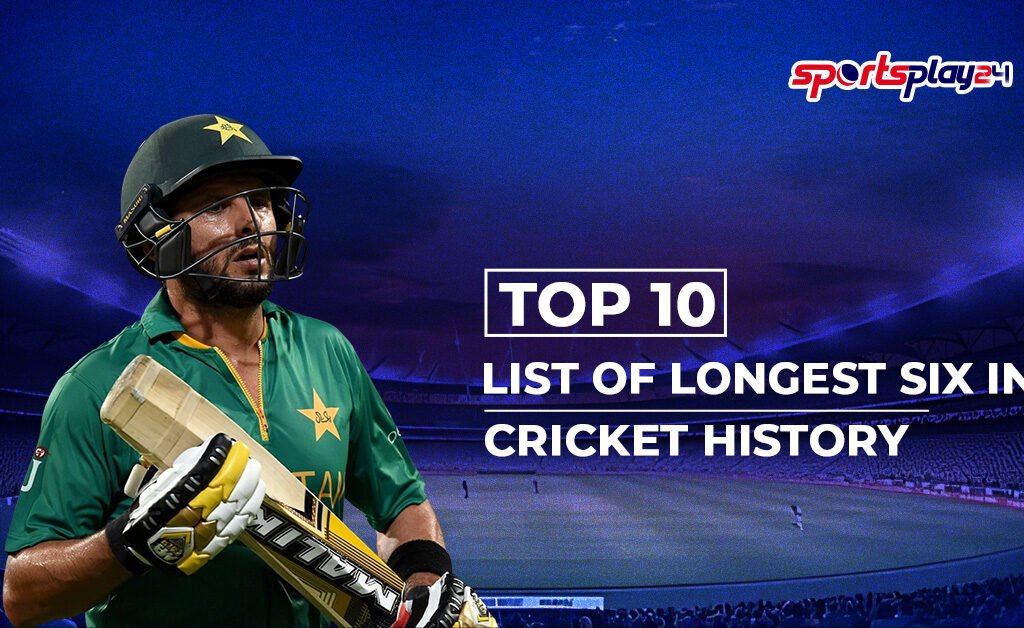
Cricket has given us many unforgettable moments, but nothing excites me more than watching a batsman launch the ball into the stands with pure power and timing. Over the years, I’ve closely followed official records, ICC match footage, and verified tournament archives to analyze some of the longest six in cricket history.
While exact measurements can sometimes vary depending on stadium architecture and broadcast estimation methods, the distances mentioned below are widely reported in international broadcasts, official match coverage, and credible cricket sources.
1. Shahid Afridi – 158 Meters (vs South Africa, 2013)
When discussing the longest six in cricket history, I always start with Shahid Afridi. During a 2013 ODI against South Africa in Johannesburg, Afridi smashed a massive six off Ryan McLaren, measuring approximately 158 meters.
Afridi was known for his explosive batting style and fearless approach. His ability to clear boundaries effortlessly made him one of the most dangerous hitters in ODI cricket. Even today, many fans and analysts regard this as one of the biggest six in cricket history.
2. Brett Lee – 143 Meters (vs West Indies, 2005)
Yes, a fast bowler makes this list. Brett Lee stunned everyone in a Test match against West Indies in 2005 when he hit a gigantic six measured around 143 meters at the Gabba.
Lee was primarily known for his pace, but that shot showed his raw strength. It remains one of the longest sixes in international cricket recorded during a Test match.
3. Martin Guptill – 127 Meters (T20I)
Martin Guptill has consistently been among the cleanest strikers of the ball in T20 internationals. In a T20I match, he smashed a six that was measured at approximately 127 meters.
Guptill’s ability to generate power without excessive effort makes him one of the most technically sound power hitters in modern cricket.
4. Liam Livingstone – 122 Meters (vs Pakistan, 2021)
Liam Livingstone is one of the most powerful hitters in contemporary cricket. During a T20I against Pakistan in 2021, he launched a six that traveled 122 meters, one of the longest sixes in T20 cricket.
Modern bat technology, fitness standards, and T20 strategies have elevated power hitting, but such distances still require perfect timing and strength.
5. Chris Gayle – 119 Meters (Multiple Matches)
Chris Gayle, often called the “Universe Boss,” has hit numerous massive sixes across formats, especially in T20 leagues and international matches. Approximately 119 meters was the length of one of his largest sixes.
Gayle’s high backlift, stable base, and incredible bat speed made him one of the most feared hitters in cricket history. In ICC tournaments, he consistently dominated bowling attacks with towering sixes.
6. MS Dhoni – 112 Meters (vs New Zealand, 2009)
MS Dhoni’s six-hitting ability is legendary. During a match against New Zealand in 2009, he struck a six measured at approximately 112 meters.
Dhoni’s helicopter shot became iconic, and his calm temperament under pressure often translated into clean, powerful hits at crucial moments.
7. Yuvraj Singh – 119 Meters (T20 World Cup 2007)
One of the most memorable moments in cricket history is Yuvraj Singh’s six sixes in a single over during the 2007 T20 World Cup.. One of those hits was recorded at approximately 119 meters.
That tournament, organized by the International Cricket Council, marked a turning point for T20 cricket’s popularity worldwide.
8. Corey Anderson – 122 Meters (vs India)
Corey Anderson showcased exceptional power during an ODI against India, hitting a six estimated at around 122 meters.
His aggressive batting style helped him set records, including once holding the fastest ODI century record at the time (later surpassed).
9. Mark Waugh – 120+ Meters (Perth Test)
Mark Waugh may not be known as a typical power hitter, but he once smashed a huge six at Perth that reportedly traveled more than 120 meters.
The WACA pitch in Perth is known for its bounce and pace, making such shots even more impressive.
10. AB de Villiers – 111+ Meters (Multiple Formats)
AB de Villiers combined innovation with brute force. Across formats, he hit multiple sixes beyond 110 meters.
His ability to manipulate field placements and strike cleanly 360 degrees around the ground earned him global recognition as one of the most complete modern batters.
What Determines the Longest Six in Cricket?
From my experience analyzing match data and watching countless games, several factors influence the longest six in cricket history:
1. Bat Speed and Timing
2. Stadium Dimensions
3. Ball Condition
4. Altitude and Weather
5. Format of the Game
Final Thoughts
The top 10 list of the longest sixes in cricket history reflects a blend of raw power, fearless intent, and exceptional timing. From Shahid Afridi’s monstrous hit to modern-day power strikers like Liam Livingstone, cricket continues to evolve.
While technology improves measurement accuracy, the excitement remains timeless. As a cricket analyst who closely follows official data and verified match reports, these sixes represent some of the most extraordinary power-hitting moments in the sport.
Cricket will continue to produce bigger hitters, stronger athletes, and perhaps even longer sixes. But for now, these legendary strikes remain etched in cricket history.
FAQs
1. Who hit the longest six in cricket history?
Shahid Afridi is widely credited with hitting the longest six in cricket history, measured at approximately 158 meters during an ODI against South Africa in 2013.
2. What is the longest six ever recorded in international cricket?
The longest six recorded in international cricket is around 158 meters, hit by Shahid Afridi in a One Day International match.
3. Who hit the longest six in T20 International cricket?
Liam Livingstone holds one of the longest six records in T20Is, hitting a 122-meter six against Pakistan in 2021.
4. Has MS Dhoni hit a 100+ meter six?
Yes, MS Dhoni has hit multiple sixes over 100 meters, including a 112-meter six against New Zealand in 2009.
5. How are six distances measured in cricket?
Six distances are measured using broadcast-tracking technology, stadium-mapping systems, and ball-tracking tools approved under International Cricket Council match standards.

